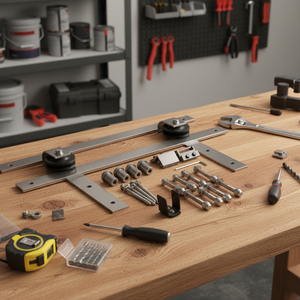
China Wholesale Modern Durable Aluminium Barn Door Soft Close Invisible Sliding Door System Hardware 1 Year Warranty
Concealed track dampening mechanism offering silent operational travel up to 100,000 cycles for hospitality suites.

As an international bespoke hardware export consortium, we supply façade specialists, door manufacturers, and MEP contractors with high-tolerance components engineered from high-grade 6063-T5/6061-T6 aluminum alloys and zamak formulations. From high-torque casement mechanisms and concealed soft-close barn assemblies to industrial corner brackets, our catalog ensures mechanical continuity across high-traffic environments.
Direct factory-manufactured configurations built to rigorous international structural codes.
Concealed track dampening mechanism offering silent operational travel up to 100,000 cycles for hospitality suites.
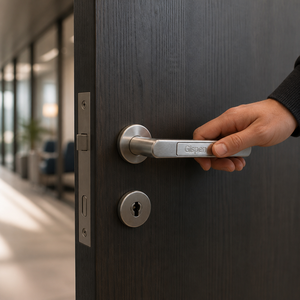
High-pressure die-cast alloy lever with heavy electrostatic powder coating suited to high-traffic commercial portals.
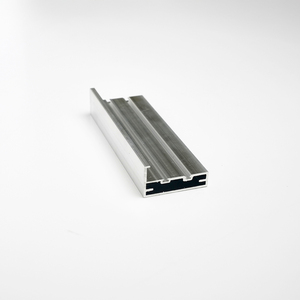
Ultra-slim architectural extruded framing profiles engineered for minimalist interior partitions and cabinet glass systems.
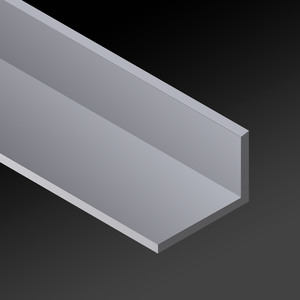
Structural 6000-T5 grade corner support delivering enhanced shear modulus under heavy wind and cyclic vibrations.
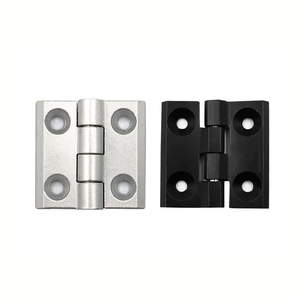
Standardised industrial profile hinge assemblies optimized for modular T-slot framing and perimeter protective barriers.
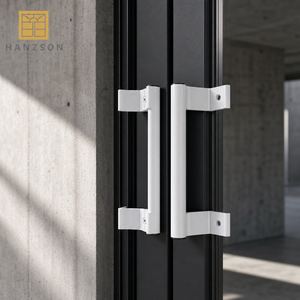
Fast-fit ergonomic operator handle with internal anti-sag springs calibrated for hospitality guestrooms and multi-family units.
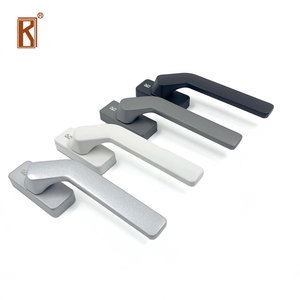
Multi-point lock interface with reinforced spindle transmission designed to match high-acoustic casement sash profiles.
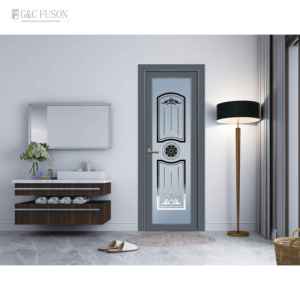
Complete architectural integration unit: Matt Black thermal casement profiles fitted with high-security hardware locking points.
Meeting ASTM, EN 13126, and AAMA standards through automated extrusion, high-precision tooling, and multi-tier surface passivation.
We deploy certified 6063-T5 aluminum for structural extruded channels and hinges, providing an ultimate tensile strength exceeding 160 MPa. For complex ergonomic levers, our high-fluidity Zamak 3 and 5 alloys or ADC12 aluminum eliminate microporosity, ensuring uniform stress distribution under continuous cyclic load.
Export components endure diverse climatic exposure. Our finishing lines execute architectural Class 1 anodizing (15-25µm film thickness) and Qualicoat-certified fluorocarbon/PVDF coatings. These surface treatments maintain gloss retention, scratch hardness (>2H), and corrosion resistance across coastal environments.
Custom OEM hardware necessitates rigorous dimensional repeatability. Multi-axis CNC milling centers hold tolerances within ±0.02 mm on gear transmissions, hinge barrel centers, and flush mortise plates, preventing frame binding and premature wear during mass fenestration installations.
Comparative baseline data for commercial project submittals and tender procurement compliance.
| Hardware Category | Base Metallurgy | Finishing Standard | Cycle Durability | Load / Force Rating | Compliance Standards |
|---|---|---|---|---|---|
| Concealed Sliding Systems | 6063-T6 Extruded Alloy | Satin Anodized (15µm) | 100,000 Cycles | Max 120 kg per door leaf | EN 1527:2019 |
| Commercial Lever Handles | Die-Cast ADC12 / Zamak 5 | Electrostatic Powder (Qualicoat) | 200,000 Cycles | 1.0 kN Operational Torque | EN 1906 Grade 4 |
| Heavy Duty Pivot & Butt Hinges | Extruded 6061-T6 + SS304 Pin | PVD / Hard Anodized | 250,000 Cycles | Up to 220 kg Sash Weight | EN 1935 Grade 14 |
| Industrial Extrusion Brackets | Alloy 6005A / 6060-T5 | Clear / Matte Black Anodize | Static Structural | Yield Strength ≥ 215 MPa | ASTM B221M |
| Casement Transmission Locks | Forged Brass & Zinc Core | Multi-Layer Nickel Chrome | 50,000 Cycles | Locking Point Force ≥ 800 N | EN 13126-4 |
Technological and structural evolutions steering global wholesale hardware orders through 2026-2030.
Modern building architecture mandates ultra-low profile framing where structural hardware is hidden from sight. Procurement demand is shifting toward completely invisible top-hung dampening rollers, concealed multi-point linkages, and integrated handleless profile edges that maintain acoustic ratings without visual clutter.
With global green building codes enforcing lower overall U-values (such as LEED v4.7 and German EnEV), hardware components penetrating thermal barrier zones must integrate insulating polyamide (PA66GF25) bridges or rubberized thermal boots to eliminate cold bridging and interior condensation in cold climates.
Commercial hardware tenders increasingly dictate mechatronic integration. Window actuators, drop-down acoustic drop seals, and multi-point deadbolts are being customized at the OEM level to interface natively with building automation systems via dry contact relays, Zigbee, or KNX interfaces.
Common inquiries from façade engineers, procurement officers, and overseas distributors.
To deliver an engineering quote, our design team requires 2D CAD cross-sections (DWG/DXF), 3D STEP/IGES files, target alloy specifications (e.g., ADC12, A380, 6063-T5), surface finish designations (powder RAL code or anodizing microns), and projected annual volume breakdown.
We employ automated conveyorized lines with electrostatic Swiss Gema spray guns using architectural polyester powders. Every production lot is verified via digital spectrophotometers (ensuring Delta E < 0.5 under standard illuminant D65) and backed by cross-hatch adhesion testing (ISO 2409).
Yes. We specialize in engineering adapted baseplates, sliding rollers, and euro-groove clamping cleats calibrated to proprietary profile designs including Schüco, Reynaers, Cortizo, and standard 2020 to 5050 industrial extrusion profiles.
Finished components receive electrostatic protective film, custom high-density molded EPE foam compartments, moisture-absorbing silica gel packs, and heavy multi-wall corrugated cartons secured inside fumigated seaworthy plywood crates to withstand prolonged maritime conditions.
Rapid CNC-machined functional prototypes or 3D SLA check samples are completed within 7 to 10 working days. Steel die-casting or extrusion tooling requires 20 to 25 days, followed by initial sample inspection reports (ISIR) and mass export delivery within 30 days post-approval.
We regularly facilitate independent on-site pre-shipment inspections (PSI) conforming to ISO 2859-1 (AQL 1.0/2.5 criteria), granting unhindered access to raw material mill test certificates, spectral alloy analysis, and destructive cycle test benches.
Submit your hardware schedules, extrusion blueprints, or tender specifications. Our senior engineering team conducts full structural compatibility reviews and offers direct factory cost analysis within 24 hours.